A practical guide to the Chinese standards behind efficient underfloor heating systems.
1. Boiler Selection
Q: What is the difference between Level 1, Level 2, and Level 3 energy-efficiency boilers?
Simply put, an energy-efficiency rating indicates how effectively a boiler converts fuel into usable heat. The higher the efficiency level, the more heat is produced from the same amount of gas, resulting in lower operating costs.

Q: What does “30% partial-load thermal efficiency” mean?
A boiler does not operate at full capacity all the time. Once the desired room temperature is reached, it reduces output to maintain a stable indoor climate.
Therefore, boiler efficiency is tested under two operating conditions:
· Full-load operation: During system startup or extremely cold weather.
· 30% load operation: During temperature maintenance, which represents the majority of real-world operating time.

Boilers that achieve the highest efficiency ratings are typically condensing boilers. These systems require a condensate drainage connection and are capable of recovering heat from exhaust gases, significantly improving energy efficiency and reducing long-term fuel consumption.
Recommended Selection
· In regions with heating seasons longer than three months or relatively high gas prices, a Level 1 energy-efficient boiler can provide greater long-term savings.
· For households with lower heating demand or tighter budgets, a Level 2 boiler is usually sufficient.
Q: Which boiler brands are widely trusted?
Among mainstream manufacturers, Vaillant, Bosch, Rinnai, and Viessmann are known for reliable performance and strong after-sales support.
For integrated heating and cooling systems, York and Daikin remain among the most widely adopted brands. When choosing a boiler, always verify that service and maintenance support are available in your local area.
2. Insulation Layer
Q: What is the purpose of the insulation layer?
The insulation layer is installed between the structural floor and the heating pipes. Its primary function is to direct heat upward into the living space while minimizing heat loss into the floor structure below.
Without effective insulation, a significant portion of the heat generated by the system is wasted, reducing efficiency and increasing operating costs.

Traditional wet underfloor heating systems commonly use XPS insulation boards.
According to the Chinese industry standard Radiant Heating and Cooling Technical Specification (JGJ 142-2012, Section 4.2), XPS insulation boards used in underfloor heating systems must meet specific performance requirements.

These values represent minimum requirements rather than ideal targets. Products that significantly exceed these benchmarks generally provide better insulation performance and improved energy efficiency.
Q: Which type of XPS insulation board is the best choice?
Common XPS insulation boards can generally be divided into three categories:
Recycled-Material XPS Board
· Manufactured from low-grade recycled materials
· Lower insulation performance
· Rarely used in modern residential applications
Standard White XPS Board
· Cost-effective entry-level solution
· Produced with partially recycled materials
· Long-term thermal performance may vary
XPS Board (100% Virgin Material)
· Premium energy-saving solution
· Manufactured from 100% virgin raw materials
· Higher compressive strength
· More stable thermal performance over time
The insulation layer is often overlooked during installation, yet it has one of the greatest impacts on long-term comfort and energy consumption.
Even when the same boiler and heating pipes are used, differences in insulation quality can lead to noticeable differences in heating costs and overall system efficiency.
For projects focused on long-term performance and energy savings, XPS Board is highly recommended.
Among available brands, Earthmother has earned a strong reputation through more than 20 years of experience in the underfloor heating industry, offering stable product quality and proven thermal performance.

3. Underfloor Heating Pipes
Q: There are many pipe materials available—PE-RT, PE-X, and PB. Which one should I choose?
All three materials are widely used in underfloor heating systems and can provide reliable performance when properly installed.
The primary differences relate to temperature resistance, flexibility, and cost.

For most residential applications, PE-RT Type II offers an excellent balance of performance, durability, and affordability.
Popular brands include REHAU, MENRED, Georg Fischer, Rifeng, and Vasen.
Q: How close should heating pipes be installed? What is the difference between 16 mm and 20 mm pipes?
Larger pipe diameters provide greater heat output per circuit, allowing wider installation spacing.
According to industry practice, pipe spacing typically ranges from 150 mm to 300 mm, depending on room size and heating demand.
Recommended spacing:
ApplicationPipe SizeRecommended SpacingLiving rooms & bedroomsDN16Approx. 150 mmLarge open spacesDN20Approx. 200 mmKitchens & storage roomsDN16 / DN20Up to 300 mm

Q: What inspection should be completed before the floor is covered?
One of the most important yet frequently overlooked steps is the pressure test.
Before embedding the pipes, the system should be pressurized to at least 1.5 times the operating pressure and maintained for a minimum of 30 minutes.
No leakage or pressure drop should occur during the test.
Once the floor has been completed, repairing a leaking pipe can be extremely costly and disruptive.
4. Flooring Selection
Q: Can wood flooring be installed over underfloor heating?
Yes—but only flooring products specifically designed for underfloor heating applications.
According to the Chinese national standard GB/T 41547-2022 Wooden Flooring for Underfloor Heating, the most common flooring categories include:
· Laminate Flooring
· Engineered Wood Flooring
· Cork Flooring
· Laminated Engineered Wood Flooring
Q: Will wood flooring reduce heating performance?
In most cases, the impact is minimal.
Wood has a lower thermal conductivity than ceramic tile, meaning heat travels to the surface more gradually. However, wood also retains heat for longer periods, helping maintain a stable and comfortable indoor temperature.
The Chinese national standard GB/T 41547-2022 requires flooring used with underfloor heating systems to achieve a heat transfer performance of ≥ 8°C/h, ensuring reliable heating performance when compliant products are selected.
Q: How can I verify whether a flooring product is truly suitable for underfloor heating?
The easiest approach is to compare its technical specifications with the requirements defined in GB/T 41547-2022.
Pay particular attention to two key indicators:
· Heat-induced shrinkage rate
· Moisture-induced expansion rate
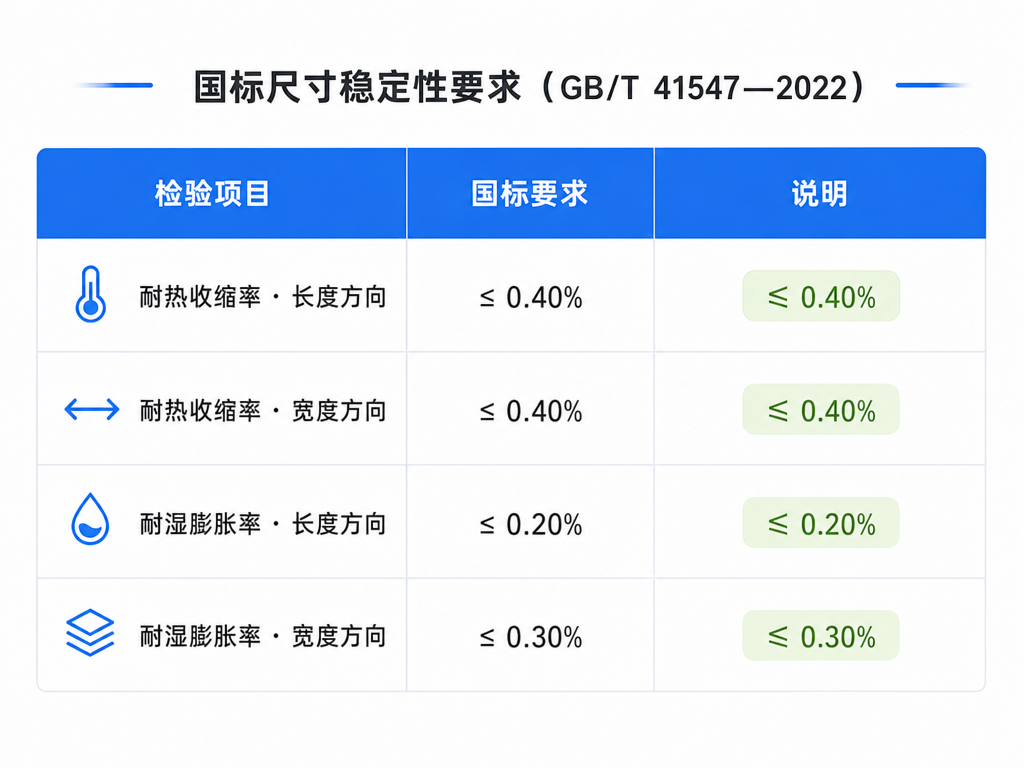
If a product specification lists values such as “Width ≤ 1.50%” or “Width ≤ 0.80%,” compare them carefully against the official standard requirements. In some cases, these values may not meet the stricter criteria specified in the standard.
Q: What other performance indicators should be considered?
Formaldehyde Emission
Because underfloor heating increases floor temperature, formaldehyde emissions become particularly important.
RatingRequirementENF Grade (Recommended)≤ 0.025 mg/m³E0 Grade (Acceptable)≤ 0.050 mg/m³
Selecting low-emission flooring helps create a healthier indoor environment while maintaining heating comfort.
Conclusion
A high-performing underfloor heating system depends on more than just quality installation—it requires every component to meet recognized technical standards.
From boilers and insulation boards to pipes and flooring, understanding the relevant requirements helps homeowners make informed decisions, improve energy efficiency, and avoid costly problems in the future.
Note: All technical requirements, performance indicators, and recommendations referenced in this article are based on current Chinese national standards (GB) and Chinese industry standards (JGJ). While regulations may differ from country to country, these standards provide valuable guidance for designing efficient, reliable, and energy-saving underfloor heating systems.