Why autumn is the ideal time to improve insulation, reduce heat loss, and prepare for a warmer, more energy-efficient home.
When the Heating Can’t Come Soon Enough
Today marks Hanlu, or Cold Dew, one of the traditional Chinese solar terms that signals the arrival of colder weather. According to China’s national weather forecasts, cold air becomes more active around this time of year, bringing sharp temperature drops to many regions.
In parts of northern China, preparations for the heating season have already begun. Some cities and counties started preliminary heating operations in early October, responding to sudden temperature drops and increasingly wide differences between daytime and nighttime temperatures.
Starting the heating early is good news for residents. But there is an important distinction: supplying heat is one thing; keeping that heat inside the home is another.
The first depends on the heating system. The second depends largely on the building itself.
Temperature Fluctuations Put Your Home to the Test
One often-overlooked detail in the weather forecast is that the temperature difference between day and night can be greater than the change from one day to the next. In parts of China, these daily fluctuations can exceed 10°C, with even larger differences in some northern areas.
For a building, this creates a daily thermal challenge.
During the day, sunlight warms the walls and floors. At night, outdoor temperatures fall, increasing the temperature difference between the inside and outside of the building. Without effective insulation, the heat accumulated during the day can escape through the building envelope.
Even within the same building, two neighbouring homes may cool at very different rates. The difference often comes down to the insulation in the walls and floors, the performance of the windows, and the treatment of thermal bridges.
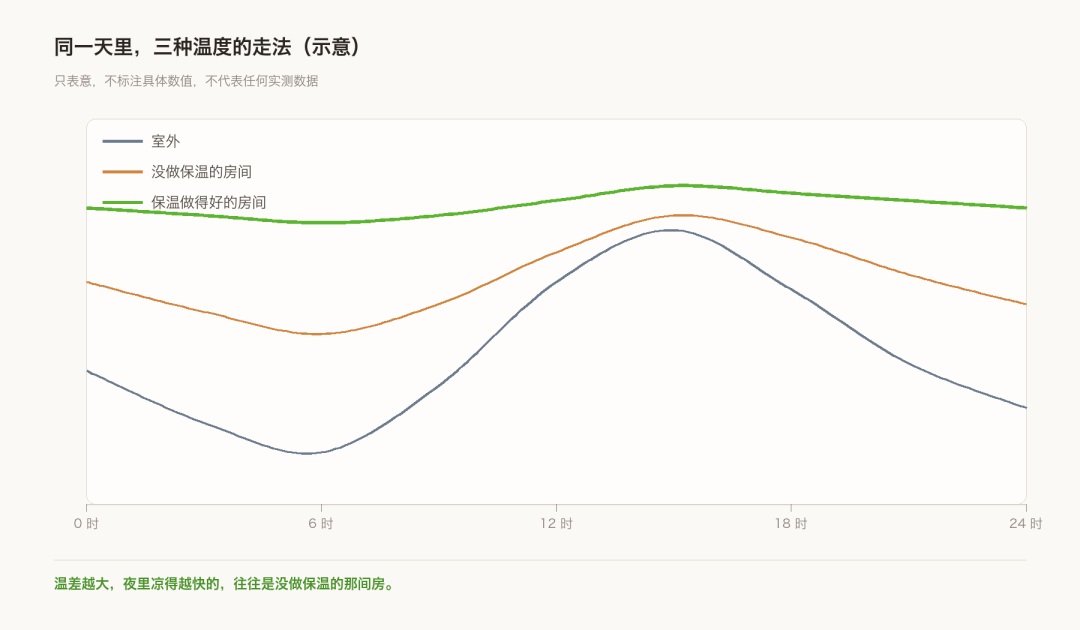
[ Illustrative diagram showing three temperature trends over a single day. Not based on measured data.]
Windows are a particularly important part of the equation. A report published through China's Ministry of Housing and Urban-Rural Development cites window heat loss as typically five to six times that of walls. Walls and floors also contribute to a building’s overall heat loss, making insulation and airtightness important considerations when improving energy efficiency.

The Best Time to Find Problems Is Before Winter
The period between early autumn and the start of winter offers a valuable window for home improvements. Indoor and outdoor temperatures are beginning to diverge, yet central heating may not be running consistently in many areas.
This is when the weak points in a home's thermal performance can start to become noticeable. North-facing rooms, exterior walls, and cold floor surfaces may feel particularly uncomfortable in the early morning or late at night.
These signs are worth investigating, but a cold wall does not automatically mean the insulation is inadequate. The cause could be insufficient wall insulation, air leakage around windows, a thermal bridge, or simply the wall’s orientation.
The more serious problems may emerge after the heating season begins. When warm indoor air meets a sufficiently cold surface, moisture can condense. Corners, window frames, and other thermal-bridge areas are particularly vulnerable. Persistent moisture can eventually contribute to mould growth, damaged paint, or bubbling wallpaper.
Addressing these problems after the heating is running and the home is occupied can be more disruptive and costly than planning ahead.
Older buildings deserve particular attention. According to an expert interpretation published by China's National Development and Reform Commission in March 2024, many residential buildings constructed before 2000 in northern China have energy-efficiency performance below modern expectations. Many homes built before 2010 in China's hot-summer, cold-winter climate zone also lack adequate energy-saving measures.
For these buildings, improving insulation can be an important step towards better thermal comfort and reduced heat loss.
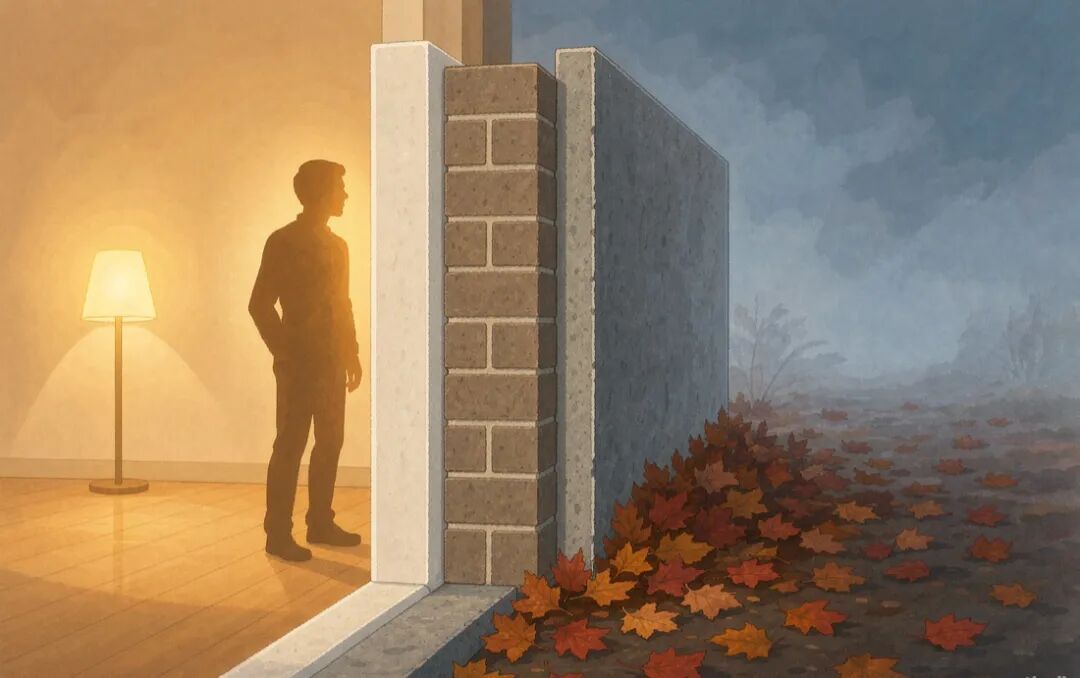
Where You Invest Determines Where the Heat Stays
Before the first really cold night arrives, there are three practical steps homeowners can take.
1. Identify the Cold Spots
Visit the rooms you use least, preferably early in the morning or late at night. Pay attention to exterior walls, corners, window surrounds, and floor surfaces.
Make a note of the areas that feel noticeably colder than the rest of the home. This simple check is not a substitute for a professional thermal assessment, but it can help you identify where further investigation may be worthwhile.
2. Plan Insulation Alongside Your Renovation
If you are renovating, consider insulation as part of the overall project rather than an afterthought.
In apartments where changes to the exterior façade are restricted, internal wall insulation may be a practical alternative. Insulation composite boards can be installed on the room-facing side of the wall, often without a separate stud framework, depending on the system and substrate.
For floor renovations, a dry underfloor heating system can also be worth considering. Unlike conventional wet systems, dry systems can avoid a cement screed, helping to reduce floor build-up and preserve valuable ceiling height.
Every solution has its limitations. Internal insulation reduces the usable room area slightly, and thermal bridges around corners, windows, and junctions require careful detailing. The right solution depends on the building structure, local requirements, and the intended finish.
Discuss these details with your installer before finalising the design.
3. Check the Materials, Not Just the Price
Insulation performance matters, but material quality and fire performance should also be part of the selection process.
When comparing insulation boards, check whether they are made from virgin or recycled raw materials where this is relevant to the product specification, and verify that their declared fire performance meets the requirements applicable to your project.
Ask for the relevant test reports and technical documentation, and make sure the product specifications match the materials being supplied.
At Earthmother, transparency is part of how we approach insulation manufacturing. Our XPS Board production workshop is available through a 24-hour livestream on our mini-program, allowing viewers to see production activities, including material feeding and cutting, in real time.
We believe that visibility into the manufacturing process provides a useful additional reference when evaluating insulation products, alongside technical specifications and test reports.

A Warmer Home Starts Before the Heating Comes On
In many northern Chinese regions, earlier heating preparations are becoming a practical response to increasingly unpredictable autumn temperatures. But regardless of when the heating starts, a home's ability to retain warmth remains essential.
Good insulation helps reduce heat transfer through the building envelope, supports more stable indoor temperatures, and can improve overall thermal comfort. Identifying weak points before winter also gives homeowners more time to compare solutions and plan renovation work.
There is an old Chinese saying: “Keep your feet covered when Cold Dew arrives.” It is a reminder to protect ourselves as the weather turns colder.
Our homes cannot tell us what they need, but cold floors, chilly walls, and recurring condensation can offer useful clues.
Give your home the insulation it needs before winter makes the decision for you.
Sources
- CCTV News, Cold Dew seasonal weather report, October 8, 2026.
- Local heating announcements from Ningwu County, Shanxi Province, and Chayouqian Banner and other areas of Ulanqab, Inner Mongolia, reported by Chinese news outlets.
- National Development and Reform Commission of China, “Expert Interpretation II: Strengthening Energy Conservation and Carbon Reduction Management Throughout the Building Lifecycle,” March 21, 2024.
- Ministry of Housing and Urban-Rural Development of China, report carried by China Construction News, August 23, 2024.
- China Construction News, interview published June 30, 2025.